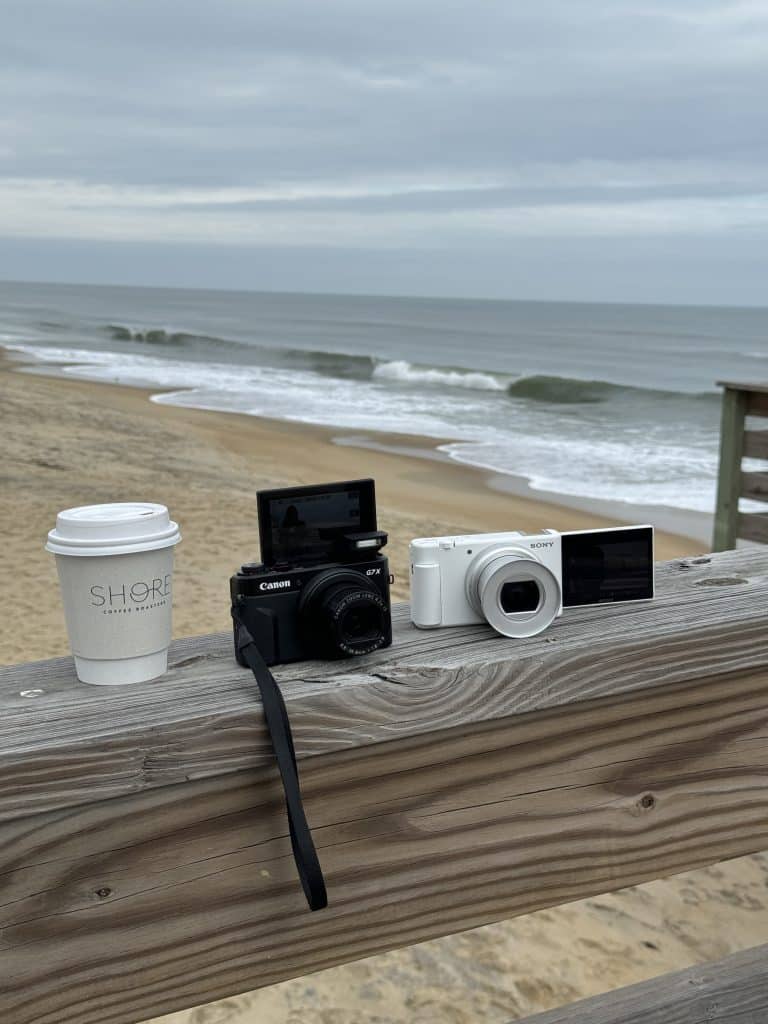
If you’re stuck choosing between the Sony ZV-1 and the Canon G7X Mark III, you’re not alone. Both are compact vlogging powerhouses that have gone viral in recent years—and as someone who’s owned and used both extensively, I wanted to break down my honest thoughts, pros, cons, and what might help you make the best decision.
Design & Build
At first glance, both cameras look sleek and compact. But a few small differences matter:
Canon G7X feels sturdier, more professional, and has a faux leather grip that gives it a premium vibe.
Sony ZV-1 is slightly wider and thicker (by about 2mm), which might seem small but made a difference when fitting it into my tiny camera case.
Weight: Canon is slightly heavier, but not by much.
Color options: Sony ZV-1 wins with its eye-catching white model (though beware, it stains easily!).
Flip Screen & Menu
Flip Screen: Sony’s screen flips to the side and auto-powers on when opened. Canon flips up, which feels more natural if you’re used to looking just above the lens.
Touchscreen: Canon wins big here—its touchscreen works for focus and navigating the menu. Sony’s isn’t touch-sensitive for menus.
Menu Experience: Canon’s UI feels more intuitive, while Sony’s can feel outdated.
Video Quality & Features
Background Blur: Sony has a dedicated button for instantly creating background blur (bokeh), which is a game-changer for creators.
Color Profile: Sony has a flattering color palette developed after extensive user testing. It gives warm, slightly enhanced skin tones.
Stabilization: Both are solid, but Sony crops the frame more when stabilization is on. I had to buy a wide-angle lens to fix the tight crop.
Mic Input: Sony has an external mic jack. Canon does not (unless you go for the Mark II).
Recording Limit: Sony has a 15-minute limit per clip. Canon doesn’t.
Speed & Usability
Startup time: Canon powers on immediately. Sony takes a few seconds—enough to miss spontaneous moments.
Recording button: Sony sometimes lags or doesn’t start recording unless you press it twice. Canon starts instantly.
Battery Life: Canon lasts a bit longer, especially during long recordings.
Charging & Accessories: Sony’s charger is bulkier. Canon’s setup feels more travel-friendly.
Flash Photography & Style
This was huge for me:
Canon G7X Mark III with flash = magic. No filter, no editing—just gorgeous, glowy, vintage-style images straight out of the camera.
Sony ZV-1 has no flash, which limits its low-light and flash photography potential.
Autofocus & Macro
Sony autofocus is slightly faster, especially for tiny objects like a lighter or candle.
Canon does well with regular-sized objects, but struggles with thin items.
Both refocus quickly when you move in and out of frame—great for vlogging.
Connectivity & Uploading
Canon app is way easier to use for transferring photos and videos to your phone. One click, and it’s there.
Sony requires third-party tools or complex file navigation (with folders inside folders), and I couldn’t even upload video to my iPhone easily.
Hidden Features That Surprised Me
Sony has better macro support, and can be paired with an external mic.
Memory card compatibility: One of my memory cards wasn’t recognized by Sony but worked fine in Canon.
- Canon has portrait modes like “Starry Sky,” “Blurry Background,” and more. Super fun if you like film-inspired photos.
Which One Should You Buy?
Go with Canon G7X Mark III if you want flash photos, fast startup, intuitive touchscreen menus, better transfer to your phone, and a reliable vlog companion for everyday moments.
Go with Sony ZV-1 if you love background blur, better color science, fast autofocus, and the ability to use an external mic. It’s especially strong for YouTube or sit-down videos where you don’t need to rush.
Where I Found My Canon
I live in NYC, and Canon was sold out everywhere—even used versions were overpriced. I ended up calling dozens of camera stores and finally found one at H&B Photo in Midtown Manhattan, even though their site didn’t show it in stock. Moral of the story: call stores directly instead of relying on what you see online.
Final Thoughts
Both cameras are amazing, and each has its strengths. For me, Canon wins for spontaneous content, ease of use, and flash photography. Sony shines for stylized video, background blur, and editing flexibility. If you can afford both, they complement each other beautifully. But if you’re choosing just one—consider your priorities and style.